Work and money decision tool
Should I Take a Pay Cut?
A lower salary does not always mean a worse deal. Compare the money you would give up with changes in your time, monthly budget, commute, flexibility and career situation. The tool uses the take-home pay you enter rather than estimating taxes from gross salary.
Step 1 of 5Pay
Your comparison
Your Pay-Cut Trade-Off
What You Gain
Financial & Time Details
Think About This Before Deciding
A Number Worth Considering
This comparison is for information and reflection, not financial or career advice. Check taxes, benefits and offer details independently.
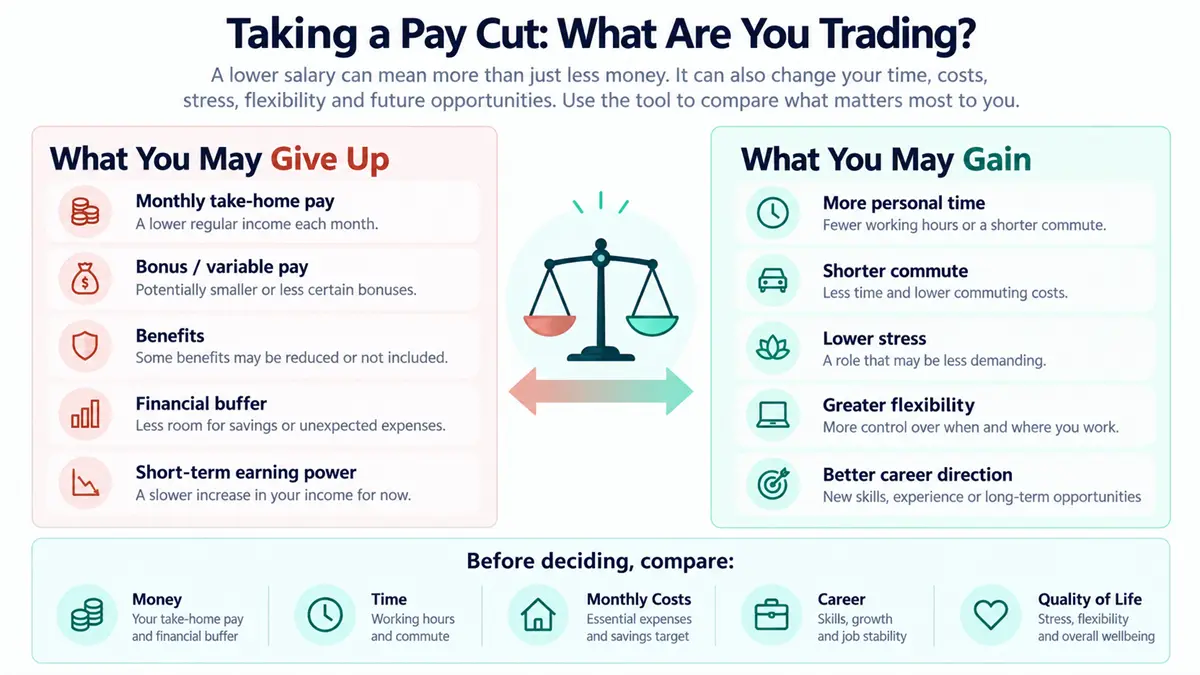
The bigger picture
What does taking a pay cut really mean?
Taking a pay cut means accepting less regular take-home pay, but the full trade-off can involve more than money. Working hours, commuting, benefits, bonuses, stress, flexibility and future career opportunities can all change with a new role. Because taxes and payroll deductions vary by country and individual, this tool compares the take-home amounts you enter rather than trying to estimate them.
When can a pay cut make sense?
A lower-paying role may still offer meaningful trade-offs, such as fewer working hours, a shorter commute, lower stress, more flexibility or a stronger long-term career path. Whether those gains justify the lower pay depends on your financial margin and what matters most to you.
When should you look more closely?
Look more closely at the numbers if the new role leaves very little monthly buffer, increases financial pressure, reduces important benefits, offers less job stability, or relies heavily on uncertain bonuses or future pay increases.
Take-home pay and committed time
The tool compares your regular monthly take-home pay with the work and commute time you enter. Annual estimates use 52 weeks and exclude optional bonuses from recurring hourly comparisons. This is a simple decision aid, not an official hourly wage calculation, and it does not adjust for holidays or paid leave.
Questions before accepting
Before accepting a lower-paying role, confirm the benefits, expected working hours, remote or hybrid terms, bonus conditions, salary-review cycle, promotion opportunities, probation terms and what will be expected of you in the role.
Common questions
Pay-Cut Decision FAQ
Is taking a pay cut always a bad career move?
No. Salary is important, but a lower-paying role may also change your working hours, commuting costs, flexibility, stress, benefits and future opportunities. Whether the trade-off works for you depends on your finances and priorities.
How much of a pay cut is too much?
There is no universal percentage. Look at whether the new take-home income covers your entered commitments, how much financial buffer remains, and what you would gain in return for the lower pay.
Should I take a pay cut for less stress?
Lower expected stress can be valuable, especially if it affects your health or life outside work. Check what evidence suggests the new role will actually be less stressful and whether the lower income remains workable.
Should I take a pay cut to work from home?
Compare the salary reduction with commuting time and costs, flexibility, home-working expenses and the value you place on regained time. Remote work is valuable only if the changes it brings are useful to you.
How do I calculate the percentage of a pay cut?
Subtract the new regular monthly take-home from the current regular monthly take-home, divide by the current regular monthly take-home, then multiply by 100. Formula: (Current monthly take-home − New monthly take-home) ÷ Current monthly take-home × 100. Optional annual bonuses are compared separately.
Why does the tool ask for take-home pay instead of gross salary?
Take-home pay is the amount available for monthly expenses, debt payments and savings. Because taxes and payroll deductions vary by country and individual, the tool uses the amounts you enter instead of trying to estimate them.
Should I include bonuses and benefits when comparing jobs?
Include realistic take-home bonus or variable-pay estimates and compare health coverage, retirement contributions, paid leave and other benefits separately. The tool does not assign an arbitrary monetary value to benefits.
How should I compare pay with shorter working hours?
Compare annualized take-home pay with total work and commute hours. This tool shows take-home pay per work-and-commute hour as a simple comparison, not an official hourly wage.