Date calculator

Notice Period Calculator

Calculate your estimated last working day from your resignation date and notice period.

Your details

Calculate your notice end date

Select the date you submitted or plan to submit your resignation.

Notice Period
Counting Method

Your contract or employer policy determines which method applies.

Notice Start Rule
Advanced options

Leave Adjustment

Choose the treatment confirmed by your employer; there is no universal rule.

Estimated Last Working Day

Add your resignation details to calculate an estimated date.

Simple process

How the Notice Period Calculator Works

This last working day calculator turns your notice terms into a clear estimated date.

  1. 1Select resignation date

    Use the date you resigned or expect to resign.

  2. 2Enter notice length

    Choose a preset or enter days, weeks, or months.

  3. 3Choose how to count

    Select calendar or working days and the start rule.

  4. 4Review the result

    See the estimated last working day and period details.

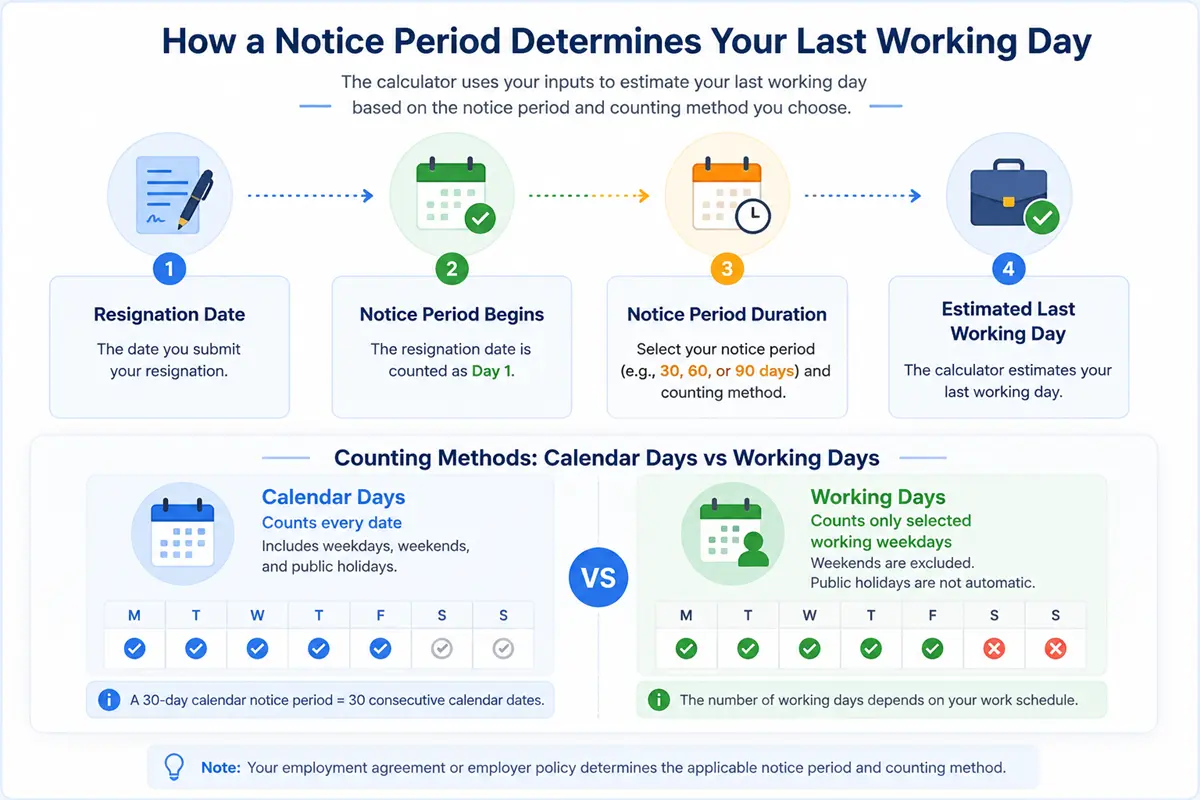
Notice Period Calculation at a Glance

Notice period timeline showing resignation date, notice period duration, calendar days versus working days, and estimated last working day

Counting choices

Calendar Days vs Working Days

Calendar days count every date, including weekends. A 30-day calendar notice period therefore covers 30 consecutive calendar dates.

Working days count only the weekdays included in your selected work schedule. The calculator supports common workweek patterns and custom working days. Public holidays are not automatically excluded.

Your employment agreement or employer policy determines which counting method applies.

Important variables

What Can Change Your Last Working Day?

  • When your notice period officially begins
  • Whether notice is counted in calendar or working days
  • Your normal work schedule and weekends
  • Public holidays, where applicable
  • Approved leave during the notice period
  • Early release agreed with your employer
  • Notice waiver or notice-period buyout

Your calculator result is an estimate. Your employer or HR team should confirm your official last working day.

Notice period examples

30-, 60-, and 90-Day Notice Period Examples

These examples use calendar days and count the resignation date as Day 1.

30 days

30-Day Notice Period Example

Resignation submitted on 1 September → estimated last working day 30 September.

60 days

60-Day Notice Period Example

Resignation submitted on 1 June → estimated last working day 30 July.

90 days

90-Day Notice Period Example

Resignation submitted on 1 July → estimated last working day 28 September.

Notice period basics

Common Notice Periods

Notice periods vary by employer, employment contract and location. Common arrangements include 30, 60 and 90 days, although some employers use shorter, longer or month-based notice periods.

Always use the notice period stated in your employment agreement or employer policy. If your notice is expressed in months rather than days, select the appropriate unit in the calculator because a calendar month is not always the same as 30 days.

Tip: A 3-month notice period and a 90-day notice period can produce different end dates.

Common questions

Notice Period Calculator FAQ

How do I calculate my last working day after resignation?

Select your resignation date, enter your notice period, and choose whether it is counted in calendar days or working days. Then choose whether the resignation date counts as Day 1 or counting starts the next day. The calculator will estimate your last working day.

Is the resignation date included in the notice period?

It depends on your employment agreement and employer policy. Some notice periods count the resignation date as Day 1, while others begin the following day. The calculator lets you use either method.

Does a 30-day notice period include weekends?

If your notice period is based on calendar days, weekends are included. If it is based on working days, only the working weekdays selected in the calculator are counted. Check your employment agreement or employer policy to determine which method applies.

How is a 60-day notice period calculated?

For a 60-day calendar notice period, count 60 consecutive calendar dates using the applicable notice start rule. If your notice is based on working days, only the selected working weekdays are counted. Enter 60 days in the calculator to estimate the corresponding last working day.

How do I calculate a 90-day notice period?

Select the 90-day preset, enter your resignation date, and choose the appropriate counting method and notice start rule. The calculator will automatically account for month and year boundaries when estimating your last working day.

Are notice periods calculated in calendar days or working days?

Notice periods may be stated in calendar days, working days, weeks, or months. The correct method depends on your employment agreement and employer policy. Use the same unit and counting method specified by your employer.

Can annual leave reduce my notice period?

Not automatically. Approved leave may reduce, extend, or have no effect on your notice period depending on your employment agreement and employer policy. Confirm how leave is treated before applying a leave adjustment in the calculator.

What happens if my last working day falls on a weekend?

In calendar-day mode, the estimated last working day can fall on a weekend. In working-day mode, the calculation ends on one of your selected working days. Your employer's policy determines the official date if an adjustment is required.

What is a notice-period buyout?

A notice-period buyout is an arrangement where payment may be made for some or all of the notice period that will not be served. Whether buyout is available, and how the amount is calculated, depends on the employment agreement and employer policy.

Can I leave before completing my notice period?

You may be able to leave earlier if your employer agrees to an early release, waives part of the notice period, or allows a notice-period buyout. The calculator can estimate the remaining period or buyout amount, but your employer must confirm the arrangement.

Can I use this calculator for a notice period stated in months?

Yes. Select Months as the notice-period unit. Month-based notice periods use calendar-month arithmetic, which means one month is not always the same as 30 days.

Is a 3-month notice period the same as 90 days?

Not always. Calendar months have different lengths, so adding three months to a resignation date can produce a different result from counting exactly 90 days. Choose Months if your employment agreement states three months, and Days if it specifically states 90 days.

Continue planning