Look at the work
We use trusted occupation data about tasks, digital work, repeated processes, physical work and human skills.
AI & automation career tool
Search your occupation to see how its day-to-day work compares with other jobs in exposure to AI and automation—and where people still matter.
Your job title doesn’t tell the whole story.
Two people with the same job title can do very different work. Answer seven quick questions about what you actually do.
Explore
Compare jobs, browse results and see where technology may change the work people do.
See jobs that rank higher when we compare the type of work people do.
See jobs that rank lower without assuming that any job is AI-proof.
Compare exposure dimensions, human strengths and career characteristics side by side.
Compare →Career categories
Loading jobs…
How it works
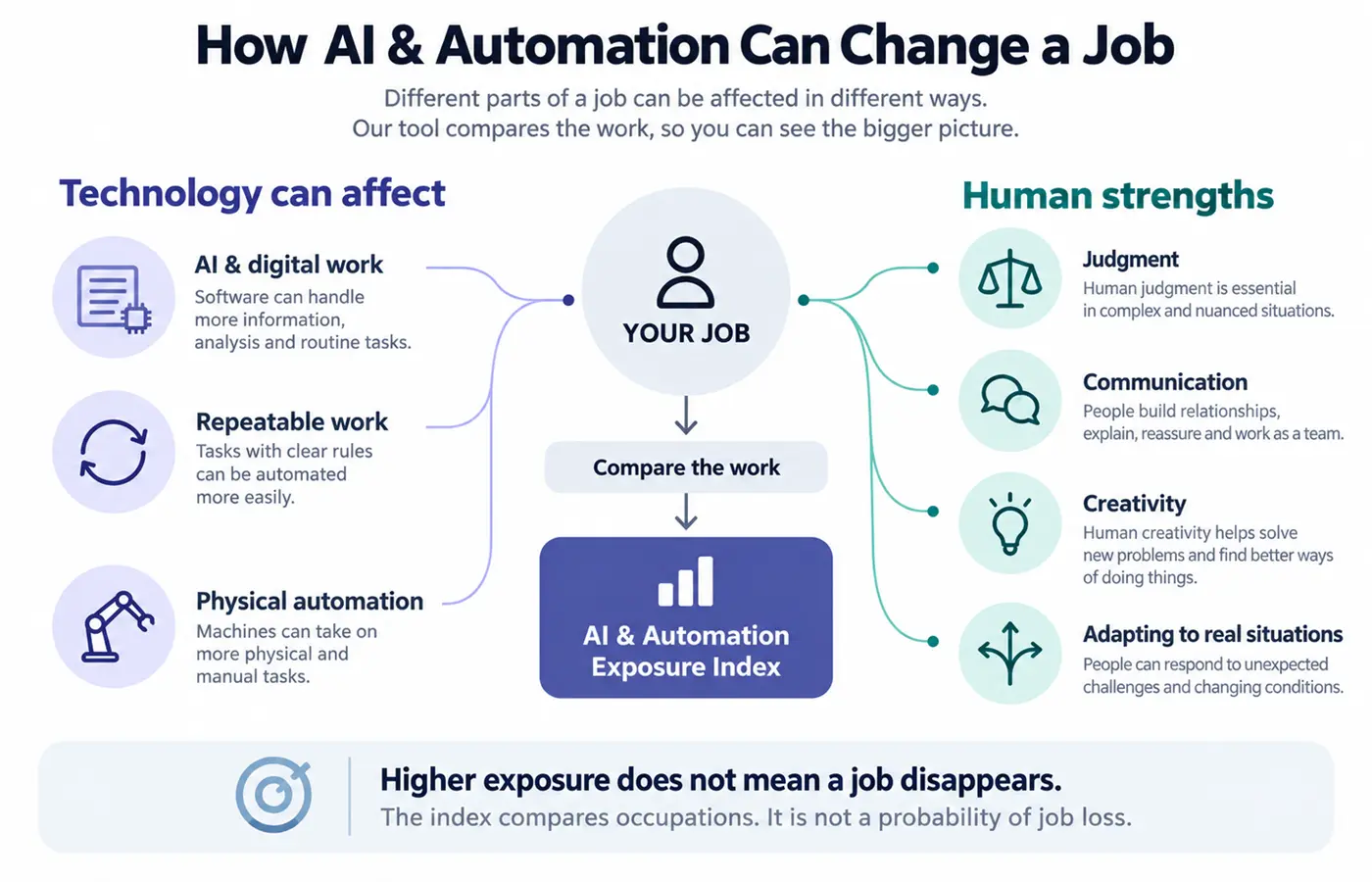
We look at information about what people actually do in hundreds of occupations. We consider how digital, repetitive and physically automatable the work is, along with how much it depends on human judgment, creativity and interaction. We then compare each occupation with other jobs.
We use trusted occupation data about tasks, digital work, repeated processes, physical work and human skills.
The tool combines those parts of the job without treating the result as a prediction of job loss.
The main number shows where the occupation sits compared with hundreds of other jobs.
The number is a comparison, not a chance that someone will lose their job. Other evidence-backed technologies may be shown separately when the score does not fully capture them.
View full methodologyVisual overview
How technology exposure dimensions interact with enduring human capabilities across modern occupations.
Understand the result
Software may help draft, classify or analyze information, while machines may assist with repeatable physical work.
A higher number means the work ranks above more occupations in exposure to AI and automation. It does not mean the job will disappear.
Technology may change one part of a role while people remain essential for judgment, trust, creativity and unusual situations.
Look at which tasks may change, where human skills matter and how your own work differs from the typical occupation.
This tool compares broad occupational characteristics using available labour-market data. Technology adoption differs by employer, industry, location and time, so the result is not a prediction of individual job loss or personal career advice.
This product includes information from the O*NET 31.0 Database by the U.S. Department of Labor, Employment and Training Administration (USDOL/ETA), used under the CC BY 4.0 license. Toolsyte has modified and scored some information; USDOL/ETA has not approved, endorsed, or tested these modifications. O*NET® is a trademark of USDOL/ETA.