Transportation Need
How often you expect to use a car, how well current transportation works, and whether you regularly carry people or substantial loads.
Car ownership decision tool
Find out how well car ownership fits your transportation needs, lifestyle, financial readiness and available alternatives.
A broader decision
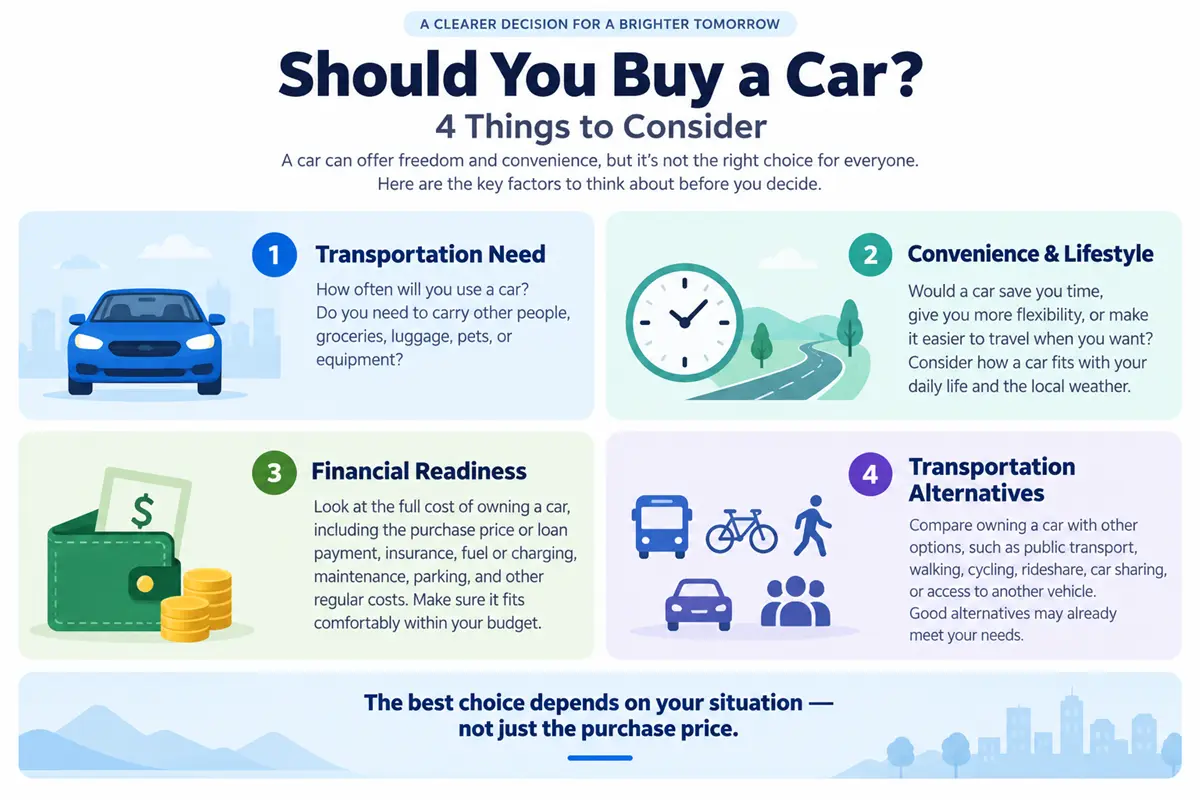
Making the payment is only one part of car ownership. A useful decision also considers how often you will drive, the time and flexibility a car may add, passenger or load needs, parking, and the alternatives already available to you.
The financial side includes the purchase or finance cost, insurance, fuel or charging, maintenance, registration and taxes where applicable, parking and depreciation. This assessment brings those practical and financial factors into one structured view without asking for your income.
Four dimensions
Each area receives its own score before the weighted fit score is calculated.
How often you expect to use a car, how well current transportation works, and whether you regularly carry people or substantial loads.
Potential time savings, travel flexibility, weather exposure, and whether parking is practical where you need it.
How comfortably the full cost of ownership fits your finances while preserving savings and other priorities.
The quality of public transport, walking, cycling, rideshare, car sharing, vehicle access, and other realistic options.
Simple process
Choose the option that most closely reflects your current situation.
Transportation need, convenience, financial readiness and alternatives are calculated separately.
See a 0–100 score, the biggest factor, useful supporting points and cautions.
This is a decision-support tool, not financial advice. Use the result as one input alongside real quotes, local rules and your own priorities.
Understanding the result
The score ranges from 0–100 and represents how strongly your answers currently support car ownership. Higher scores indicate greater practical need and convenience with stronger financial readiness; lower scores indicate that ownership may add less value or deserves more caution.
A score of 75 does not mean there is a 75% probability that you should buy a car. It is a suitability score generated from your assessment answers, not a prediction or guarantee.
Before you decide
Estimate how many days a week the car would genuinely be used and which trips it would replace. Occasional convenience may not justify year-round costs, while frequent trips with passengers, equipment, luggage or pets can create substantial practical value.
Compare complete journey times, not just driving time. Include waiting, transfers, walking, parking and congestion. Consider whether weather, irregular hours or last-minute trips make flexible access especially valuable.
Look beyond purchase price or monthly payment. Add insurance, fuel or charging, routine maintenance, repairs, registration and taxes where applicable, parking and expected depreciation. Leave room for costs that vary from month to month.
Consider whether a purchase would leave adequate emergency savings and whether ongoing costs compete with housing, debt repayment, education, family needs, retirement or other important goals.
Map the trips you make most often against public transport, walking, cycling, rideshare, car sharing, rentals or access to another vehicle. A combination of options can sometimes cover occasional needs more efficiently than ownership.
Work location, household size, health, parking and travel patterns can change. Think about how long you expect the present need to last and how easily the car could be sold or the financing changed if your circumstances shift.
Ownership may add value
More time may help
Common questions
You answer 14 questions about transportation needs, convenience, financial readiness and alternatives. The calculator scores each area, applies the stated weights and financial guardrails, and then explains your Car Ownership Fit Score.
It is a 0–100 suitability score showing how strongly your current answers support car ownership. It is not a probability, a guarantee or a measure of the quality of any particular car.
No. This tool helps you think about whether car ownership fits your present situation. It does not recommend a model, compare vehicles or calculate a loan.
Yes. The questions do not assume a particular currency, tax system or transport network. Include the ownership costs and alternatives that apply where you live.
Your answers are processed in your browser and are not submitted to Toolsyte. Temporary session storage preserves progress after a refresh and is cleared when you retake the assessment or when the browser session ends.
Consider the purchase price or finance payments, insurance, fuel or charging, maintenance, repairs, registration and taxes where applicable, parking and depreciation. The relevant mix varies by location and vehicle.
Yes. You can retake it whenever your travel needs, finances, parking situation or available alternatives change.
Ready when you are
Four short steps. No account, exact income or location required.